
The Conception by St. Anna of the Most Holy Theotokos
December 9/22
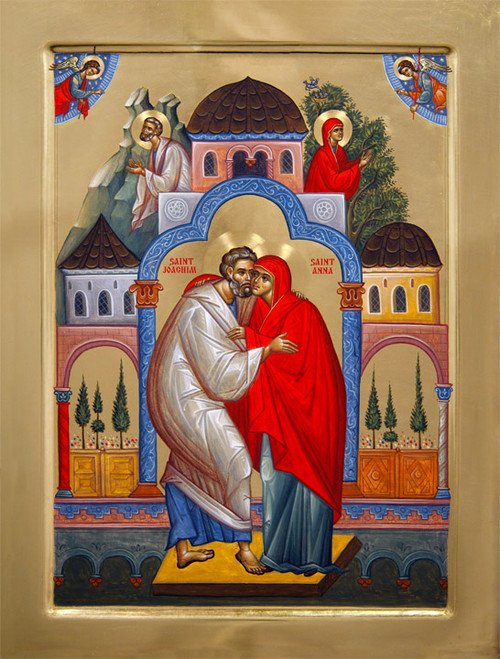
The Orthodox church accepts the validity of the Protoevangelium of James, conception by the righteous foremother of Christ, Anna. Many Fathers quote the Protoevangelium regarding this event; included in this catalogue are St. John of Damascus, St. Germanos, St. Leo the Wise and St. Gregory Palamas, to mention a few.
THE PARENTAGE OF THE VIRGIN MARY
The blessed and ever-glorious Virgin Mary, sprung from the royal stock and family of David. Her father’s name was Joachim, and her mother’s name was Anna. Her father’s family of the tribe of Judah, was from Nazareth of Galilee, but her mother’s family was from Bethlehem of Judea. Her mother Anna was the daughter of Matthan the priest, of the tribe of Levi.
Their lives were plain and righteous before the Lord, and and irreproachable and pious before men. Joachim was the shepherd of own sheep. He feared the Lord in integrity and singleness of heart. Apart from his herds, he had no other occupation. Joachim was an exceedingly rich man and was wont to bring double offerings of what the law required, saying, “The superabundance of my substance shall be for the benefit of all the people, but the offering I make for myself is so that I might find mercy and forgiveness from the Lord for my sins.”
In fact, Joachim supplied the poor and all that feared God with food. His lambs, sheep, and their wool, and whatsoever things he possessed, he would divied into three portions: one he gave to the orphans, widows, strangers and the poor; the sceond temple the tempel and its severants and those that worshiped God; and the third he kept for himselfb and all his house and family. Thus doing, the Lord that there was no man like him among the sons of Israel. He had this custom since he was fifteen years old. Thus Joachim was dear to God and kind to men.
At the age of twenty, he took a wife Anna. They had lived together, some say fifty years, but had neither a son nor a daughter. This fact saddened the righteous ones, because they could not hope that any progeny of theirs would see the Messiah. Nevertheless, they vowed that, should the Lord grant them offspring, they would dedicate it to the service of the Lord. On account of this the pious couple were wont to go up to Jerusalem, to the temple of th Lord, at each of the yearly festivals.
In the East, to be a wife without motherhood was not only regarded as a matter of regard, but also a matter of reproach and humiliation, that could even lead to divorce. If a woman could not have children, it was viewed as a curse from God, for it meant extinction. Society then usually considered the wifeas the problem. It was a constant source of embarrassment to both the wife and her husband, for the welfare of the children is a never-omitted subject of inquiry in all courteous Oriental salutations.
Even those who loved her treated her as an object of pity. Aggravating the family misfortune of barrenness was the loss of hope of mothering the Messiah or, as they belived, having seed that would behold the Messiah. Moreover, to have had children and to have lost them was the strongest possible claim upon receiving sympathy.
Jewish parents believed that a part of them lived on in their children and, therefore, looked upon children as a blessing. It followed that to be without offspring was to exist in name only. Children were also hoped for so as to keep inheritances in the family. If a woman did have children, it greatly increased her prestige in the family. For example, to avoid disgrace, we know that the wives of the patriarchs, Sarah [Gen. 16:2] and Rachel [Gen. 30:], gave their handmaidens to their husbands; other methods were adoption or polygamy. Polygamy first appeared in the reprobate line of Cain, when Lamech took two wives [Gen. 4:19].
THE FEAST OF THE DEDICATION
Now the great day of the Lord was at hand, the Feast of the Dedication (Hanukkah) and the Feast of Lights, commencing on the 25th of Chislev or Kislev (the ninth) month; November-December), which was celebrated for eight days, when the sons of Israel would bring their offerings [1 Macc. 4:52-59; 2 Macc. 10:5]. At this time, Joachim, too, was preparing his gifts for the Lord. When the high priest Reuben beheld Joachim, he despised him and spurned his gifts, saying, “It is not lawful for thee to stand among them that are offering sacrifice to God, because God has not blessed thee, so as to give thee seed in Israel. Cursed is every one who has not begot a male or female in Israel!”
Thus a hymn for this feast says, The holy Joachim and Anna brought their gift to the sanctuary, but it was not received on account of their childlessness.
Reuben then said that Joachim ought to first be freed from this curse by begetting some issue; and then only should he come into the presence of the Lord with his offerings.
A kontakion of St. Romanos the Melodist (AD 490-AD 556) speaks of the holy man’s rejection: He (Joachim) brought gifts to the temple but they were not received; the priests did not wished to accept them, since they were from a childless man who had no seed. And Joachim was scorned by the sons of Israel. But at the proper time, along with Anna, he brought in the Virgin with gifts of Thanksgiving.
Publicly disdained for childlessness, the confounded Joachim, covered with shame from this reproach that was thrown in his teeth, retreated weeping from the Court of Men the the temple of the Lord. Exceedingly grieved, he went away to the registers of the twelve tribes of the people, and said,”I shall see the registers of the twelve tribes of Israel, to see if I alone have not made seed in Israel.” Thus Joachim searched the record only to find that all the righteous had raised up seed in Israel. Saddened by this, he, nevertheless, comforted himself when he called to mind the Patriarch whom God gave a son in his latter days.
JOACHIM RETRIES INTO THE WILDERNESS
At that time, Joachim was not inclined to return home, lest his neighbours and those of his tribe, who were present and heard the rebuke of the high priest, should publicly reproach and brand him in the same manner. Therefore not retuning to his house, Joachim went to his shepherds and flocks, and took them to a far place into the mountains. There he pitched his tent and fasted, saying, “will not go down either for food or drink until the Lord my God shall look upon me; prayer shall be my food and drink.
Again, St. Romanos chants, Joachim on the mountain prayed to receive fruit from the womb of Anna; and the prayer of the holy man was accepted.
ANNA MOURNS
Anna, meanwhile, departed the Court of Women in the temple, and went home weeping bitterly. Indeed, Anna mourned doubly, saying, “I shall bewail my widowhood; I shall bewail my childlessness.”
Now the great day of the Lord was at hand and Anna put off of mourning. At about the ninth hour she went down to the garden to walk.. She saw a laurel tree and sat under it, and prayed to the Lord saying, “O God of our fathers, bless me and hear my prayer, as Thou didst pen the womb of Sarah and gave her a son Isaac” [Gen. 21:2 – 3].
Then gazing towards heaven, she noticed a sparrow’s nest in the laurel, and bemoaned her barrenness within herself, saying, “Alas, who begot me? And what womb did bear me, that I should be thus accursed before the children of Israel, and that they should reproach and and deride me in the temple of my God? Woe is me. to what can I be compared? I am not like the fowls of the heaven, because even the fowls of the heaven are productive before Thee, O Lord. Alas! to what can I be compared? I am not like the beasts of the earth, because even the beasts of the earth are fruitful before Thee, O Lord. Alas! to what can I be likened? I am not like these waters, because even the waters are productive before Thee, O Lord. Woe is me to what can I be compared? I am not comparable to the waves of the sea; for these, whether they are calm, or in motion, with the fishes which are in them, praise Thee, O Lord. Alas! to what can I be likened? I am not like this earth, because even the earth bringeth forth its fruit in season and blesseth Thee, O Lord.
On this occasion St. Romanos chants, The prayer and groaning of Joachim and Anna at their barrenness and childlessness have proved acceptable, and have come unto the ears of the Lord; and they have put forth a fruit that brings life to the world. The one offered his prayer in the mountain, the other bore her reproach in the garden. But with joy the barren woman bears the Theotokos who sustains our life.
In comparing the mother Anna with her future daughter Mary, St. Ephraim the Syrian (c.306-373) chants, The wife (Anna) proved barren, and withheld her fruit; but the bosom of Mary, bodily conceived (the Christ). To wonder at fields, and to admire plants she (Mary) needed not who received and rendered what she borrowed not. Nature confessed its defeat; the womb was aware of it, and restored what nature gave not.
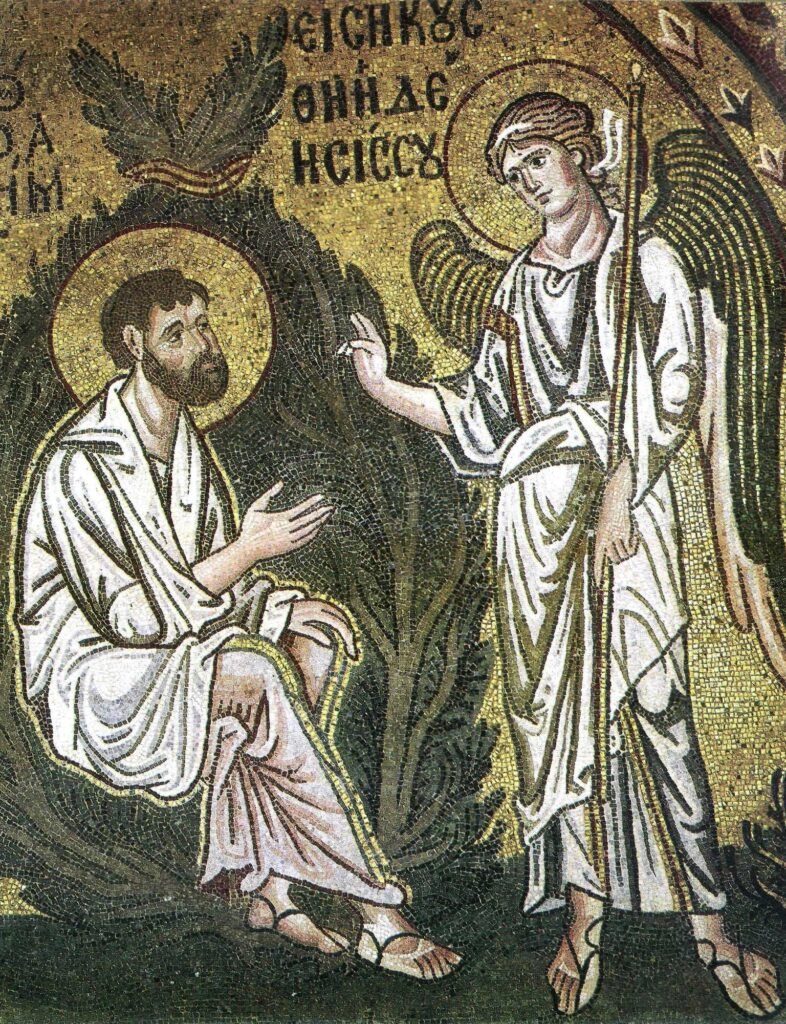
AN ANGEL APPEARS TO JOACHIM
When Joachim had been in the mountains for some time, on a certain day when he was alone, the Archangel Gabriel stood by him. Joachim was disturbed at his appearance, but the angel endeavored to restrain his fear, saying, “Fear not, Joachim, nor be disturbed by my appearance. I am the angel of the Lord and have been sent by Him to tell thee that thy prayers have been heard and that thy charitable deeds have gone up into His presence. God has seen thy shame and has heard the reproach of unfruitfulness which has been unjustly brought against thee; for God is the avenger of sin, not of nature.
“Therefore, when He shuts up the womb of anyone, He does so that He may in a more wonderful manner open it, so that which is born may be acknowledged to be the gift of God and not the product of lust. Was this not the case of the mother of thy nation, Sarah, who was barren? [Gen.17:17]. Nevertheless, in extreme old age she brought forth Isaac, in whom the promise was made a blessing to all nations [Gen. 16:2]. Rachel also, so much in favor with the Lord and beloved by the holy Jacob, was a long time barren; yet she brought forth Joseph [Gen. 30:23-24], who was not only the lord of Egypt [Gen. 41:40-41], but the deliverer of many nations that were ready to perish with hunger [Gen. 41:56-57]. Who among the judges was stronger than Samson or more holy than Samuel? And yet both their mothers were barren [Judg.13:2; 1 Sam. 1:20].
“If, therefore, the reasonableness of my words does not persuade thee, believe in fact that conceptions very late in life, and births in the case of women that have been barren, are usually attended with something wonderful. Accordingly Anna, thy wife, will bring forth a daughter to thee and thou shalt call her name MARY. According to thy vow, she shall be devoted to the Lord from her infancy, and she shall be filled with the Holy Spirit even from her mother’s womb. Mary shall not eat or drink anything unclean, nor shall her conversation or life be among the crowds of the people, but in the temple of the Lord, that it may not be possible to say, or so much as to suspect, any evil concerning her.”
The account of the Nativity of Mary portrays the Archangel Gabriel as knowledgeable of the great destiny of Mary when he utters the following sentence: “So in the process of her years, as she shall be in a miraculous manner born of one that was barren, so she shall, while yet a virgin, in an incomparable manner, bring forth the Son of the Most High, the Saviour of all nations.
“And this shall be a sign to thee of the things which I announce: When thou shalt come to the Golden Gate in Jerusalem, thou shalt meet there thy wife Anna who, lately, has been anxious from the delay of thy return, and will rejoice to see thee”. Having thus spoken, the angel departed from Joachim.
Joachim then went down and called his shepherds, saying, “Bring me hither ten she-lambs without spot or blemish, and they shall be for the Lord my God; and bring me twelve tender calves, and they shall be for the priests and elders; and a hundred goats for all the people.”
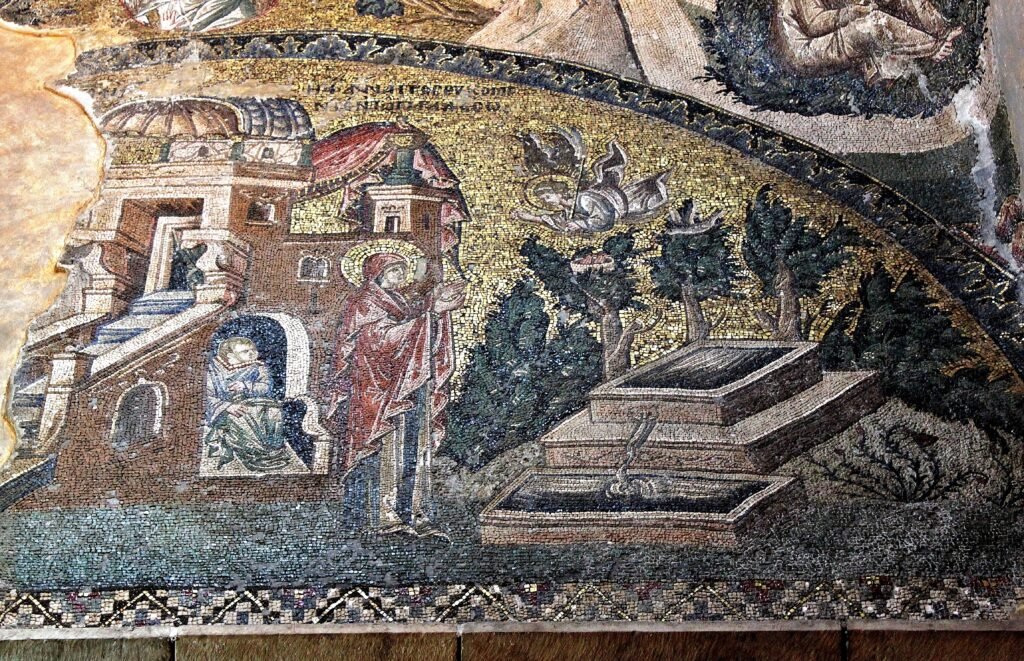
THE ANGEL APPEARS TO ANNA
While the holy Anna was in the garden, behold, the same angel of the Lord then appeared to her, saying. “Anna, Anna, the Lord hath heard thy prayer and thou shalt conceive and bring forth; and thy seed shall be spoken of in all the world.” And Anna said, “As the Lord my God liveth, if I beget either male or female, I will bring it as a gift to the Lord my God; and it shall minister unto Him all the days of its life [l Sam. 1:1 1].
Wise Anna prayed faithfully and God hearkened. And she heard the angel’s confirmation of her many entreaties….
“I am the angel who has presented thy prayers and alms before God; and now I have been sent to thee to announce
to thee that thou shalt bring forth a daughter, who shall be called Mary, and who shall be blessed above all women. She shall be full of the favor of the Lord, even from her birth. She shall remain in her father’s house until she is weaned and, thereafter, she shall be delivered to the service of the Lord. She shall serve God, day and night, in fasting and prayers. She shall abstain from every unclean thing and shall not depart from the temple until she shall reach the years of discretion.”
Saint John of Damascus (c.676-c.750), in a hymn, offers the following response of Anna: To the angel that was sent, Anna cried out in amazement, “O divine announcement! O strange utterance! I, too, shall conceive.”
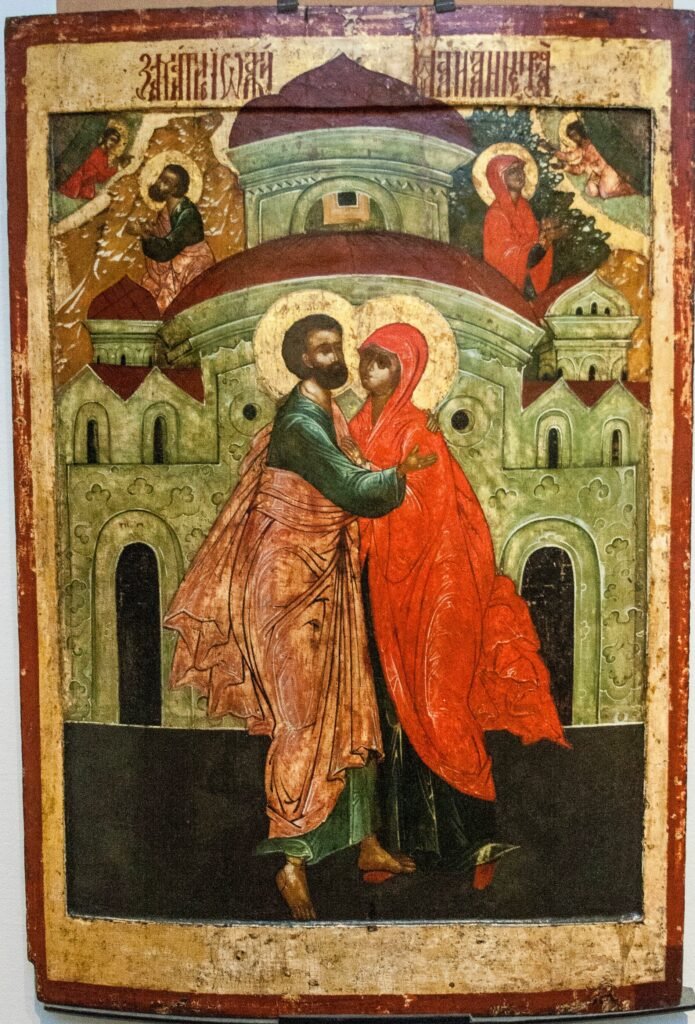
JOACHIM AND ANNA MEET AND REJOICE
Therefore, as the angel had commanded, both Joachim and Anna had set out from their respective places and went up to the Beautiful Gate of the temple. Anna hastened with her maidens and, praying to the Lord, she stood a long time in the gate waiting for him. When she was wearied with long waiting, she lifted up her eyes and saw Joachim afar off, coming with his flocks. She ran to him and hung on his neck, giving thanks to God, saying, “Now I know that the Lord hath blessed me exceedingly; for, behold I was a widow and now I am not so; I, the childless one, shall conceive!”
Then, rejoicing at seeing each other, and secure in the certainty of the promised offspring, they gave the thanks due to the Lord who exalts the humble. And Joachim rested that day.
Today the bonds of barrenness are loosed; for God hearkened to Joachim and Anna. And though it was beyond hope, He clearly promised them that they would bear a divine child, from whom would be born the uncircumscribable Himself Who became mortal.
THE CONCEPTION BY ANNA
On the following day, Joachim brought his offerings into the temple. And, having worshipped the Lord, they returned home, and Anna conceived by Joachim’s seed, and they awaited the divine promise in certainty and in gladness. When it was heard that Anna had conceived, there was great joy among all their neighbors and acquaintances, so that the whole land of Israel congratulated them.
Saint George (d. after 880), Bishop of Nicomedia chants. He Who supports all things with His word, in His mercy has hearkened unto the prayer of righteous Joachim and Anna. He has loosed them from the anguish of barrenness and given them her that is the cause of our joy.
Saint Epiphanios of Cyprus (c.315-403) writes that Mary “was a woman by nature, not to be distinguished at all from others. She was conceived by marital union and the seed of man…” And, “Mary is not God, and did not receive a body from heaven, but from the joining of man and woman; and according to the promise, like Isaac, she was prepared to take part in the divine economy.”
Thus, the pre-eternal Word has now made a throne for Himself on earth, so the Church chants, Today God Who rests upon the spiritual thrones has made ready for Himself a holy throne upon the earth He Who made firm the heavens in holy throne upon earth. His wisdom has prepared a living heaven in His love for man. For from a barren root He has made a life-giving branch spring up for us, even His Mother. God of wonders and hope of the hopeless, glory be to Thee, O Lord.
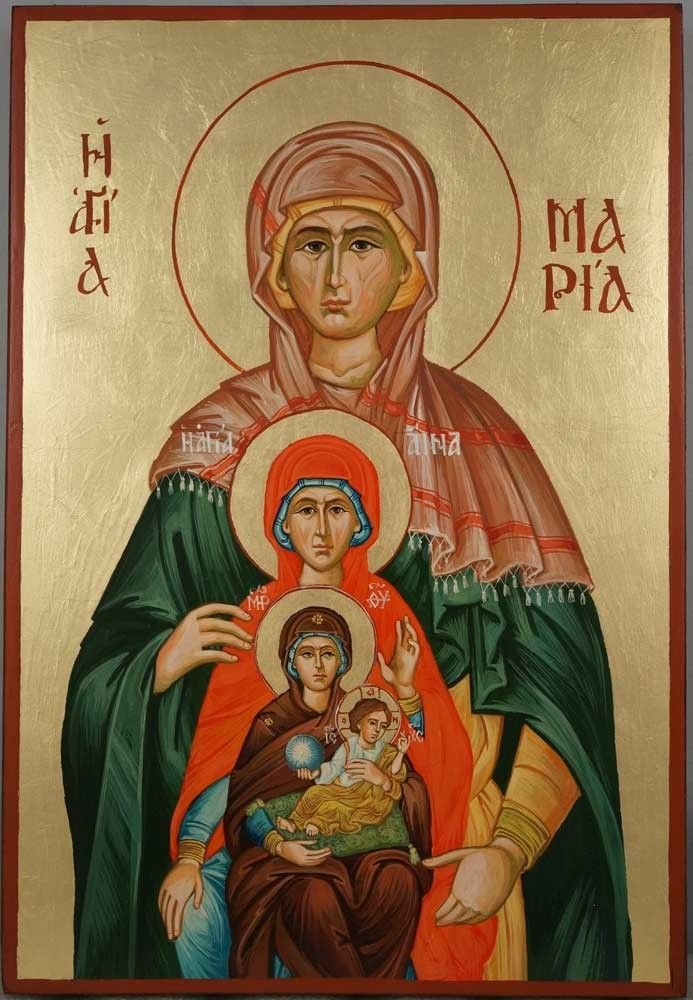
Icon showing St Maria the mother of St Anna holding her descendents according to the flesh
THE HETERODOX TEACHING OF “IMMACULATE CONCEPTION” AND “ORIGINAL SIN”
Saint Ambrose (339-397), Bishop of Milan, comments that “Of all those born of women, there is not a single one who is perfectly holy, apart from the Lord Jesus Christ…”
The Orthodox Church teaches that the Virgin Mary was conceived by Joachim’s seed and the period of gestation was nine months. None of the ancient holy Fathers say that God in miraculous fashion purified the Virgin Mary while yet in Anna’s womb. Only Jesus Christ is completely pure of every sin, while all men, being born of Adam, have borne a flesh subject to the law of sin. Many have correctly indicated that the Virgin Mary, just as all men, endured a battle with sinfulness, but was victorious over temptations and was saved by her divine Son.
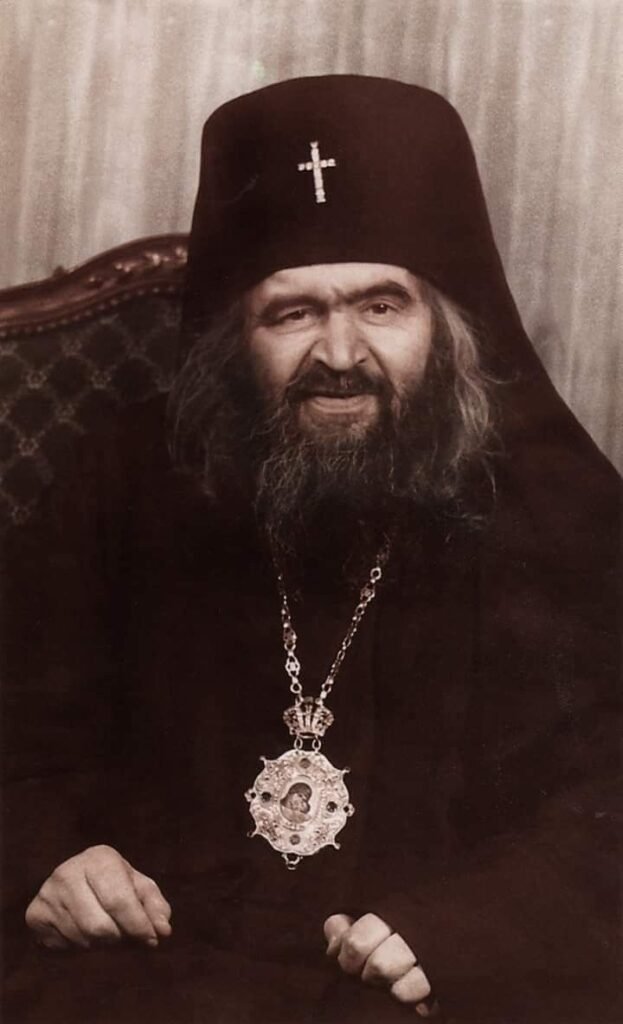
St John Maximovitch of Shanghai and San Francisco
Blessed John Maximovitch (+1966) affirms that the Church teaches that through the fall of Adam and Eve, all of the human race inherited death, becoming enslaved to the devil through the passions. The progeny of Adam and Eve are not guilty of their first parents’ tasting of the fruit; we are not being punished for this first sin or “original sin”. If, for the sake of argument, we maintain the invalid heterodox teaching that the Theotokos was preserved from this “original sin”, that would make God unmerciful and unjust. If God preserved her, why then does He not purify all men? But then that would have meant saving men before their birth, apart from their will. This teaching would then deny all her virtues. After all, if Mary, even in the womb of Anna, when she could not even desire anything either good or evil, was preserved by God’s grace from every impurity, and then by that grace was preserved from sin even after her birth, then in what does her virtue consist? She would have been placed in the state of being unable to sin.
The Virgin, as a true daughter of Adam and Eve, also inherited death. She was not in a state of never being able to die. Thus, St. John of Damascus writes on the occasion of her Dormition, O pure Virgin, sprung from mortal loins thine end was conformable to nature.
Blessed Archbishop John continues to comment that the Virgin was not placed in the state of being unable to sin, but continued to take care for her salvation and overcame all temptations. The righteousness and sanctity of the Virgin Mary was manifested in the fact that she, being “human with passions like us,” so loved God and gave herself over to Him, that by her purity she was exalted above all other creatures. Mary was to become the Mother of God, the Theotokos, not because she was to give birth to divinity, but that through her the Word became true man, God-Man.
This is article is an edited excerpt from The Life of the Virgin Mary, The Theotokos, published by Holy Apostles Convent, Buena Vista, Colorado